
It is recommended to supplement with sodium and electrolytes if fasting for more than 24 hours. In descending order of importance:
- Sodium
- 1000 – 2000 mg per day
- (1/2 – 1 tsp this is 2.5 – 3.75 grams of table salt)
- 1000 – 2000 mg per day
- Potassium
- 3800 mg/ day for men
- 2800 mg / day for women (1 – 1.5 tsp) [Source]
- Magnesium
- Aim for below 350 mg (more can cause possible nausea and diarrhea)
When breaking a fast it is also important to slowly reengage digestion as eating too much too quickly can result in refeeding syndrome
- Generally small meals like broth, smoothies, or light snacks are recommended to break a fast
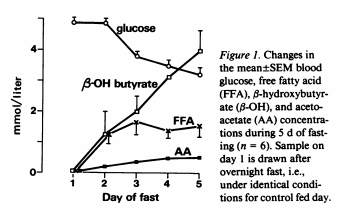
Study 1 [Fasting enhances growth hormone secretion and amplifies the complex rhythms of growth hormone secretion in man.]
- 6 Male Subjects
- aged 21 – 36
- Nonobese
- 5 day fast
Findings:
- 3-fold increase of growth hormone (GH) secretion (Very Good)
- Glucose (Sugar) and fatty acids (Fat) suppress GH
- Amino acids (Protein) can stimulate secretion of GH
- GH can increase hepatic (liver) glucose output
- This is how much glucose your liver makes for your body
- GH promote positive nitrogen balance
- This can help with tissue repair and cell growth
- GH can induce lipolysis
- This is taking stored fat and turning it into energy)
- GH plays an important role in conserving protein during starvation
- Decline in somatomedin
- A group of proteins that promote cell growth in response to GH
- Helps balance production of GH
- 5-fold increase in free fatty acids
- Elevated levels can cause insulin resistance and inflammation
- This is not ideal but indicates that fat is being mobilized (good for weight loss)
- 14-fold rise in acetoacetate
- 60 fold increase in Betahydroxy Butarate [BHB]
- Lost an average of 4.8 kg during the 5 days of fasting
Study 2 –[Fasting and exercise differentially regulate BDNF mRNA expression in human skeletal muscle]
- Sample of 6 healthy men in their early 20s
- The men exercised at 73% 100% and 133% of aerobic power as well as performed a 48 hour fast
Findings:
- Followng the fast – BDNF mRNA expression increased 3.5 fold.
- BDNF – Brain derived neurotropic factor
- promotes growth in the brain
- BDNF declines with age
- BDNF is crutial to learning and memory
- Helps protect neurons from damage
- BDNF mRNA expression is moderately increased following endurance exercise
- Energetic stressors such as fasting and exercise up-regulate BDNF in neurons
- BDNF – Brain derived neurotropic factor
- BDNF did not increase 3 hours after exercising.
- All 6 participants had an increase of BDNF while PGC-1a decreased (not good)
- PGC-1a plays a large role in cell health
- can help to cause mitochondria to multiply
- It was thought that PGC-1a was linked to BDNF but this study shows otherwise
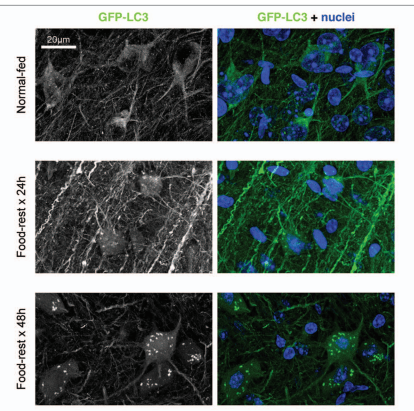
Study 3 [Short Term Fast Produces Profound Autophagy]
- 24 or 48 hour fast
- 6 – 7 week old mice
- 2-3 per group
- 50 brain cells from each group were taken and analyzed
Findings:
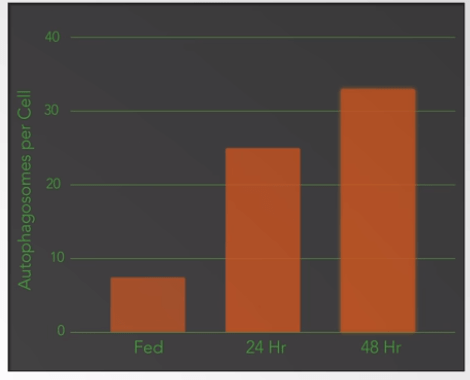
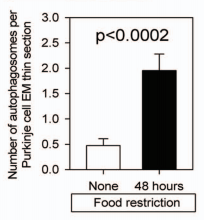
- Increased Autophagy in the brain via Autophagosomes
- Not having neuronal autophagy can lead to degenerative disease.
- More autophagy may have a neuroprotective effect.
- Autophagy in neuronal cell lines can remove toxic molecules and damaged mitochondria from neurons.
- Autophagosomes
- increased number and size in Cortical and Purkinje (Brain) cells
- these changes increased after 48 hours
- Show reduced mTOR (mammalian target of rapamycin) function
- Helps Regulate Autophagy – the less mTOR the better
- “Fasting might improve neuronal function by means that are entirely independent of caloric intake, and may instead reflect an intrinsic neuronal response that is triggered by fasting.”
- “Chronic starvation might inhibit autophagy an outcome that could damage rather than protect, neurons”
- (Do not fast too often)
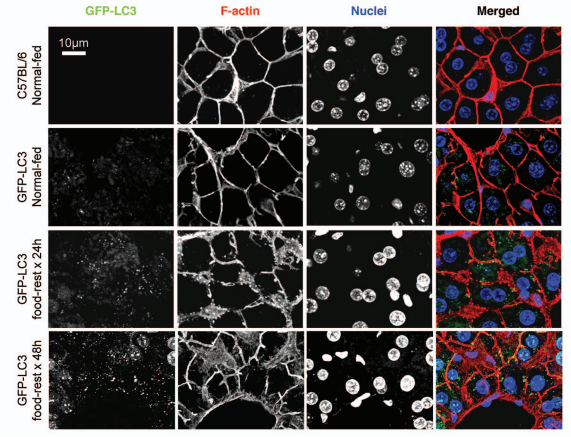
F-actin – a crucial protein for cellular function and motility
Study 4 [Safety and feasibility of fasting in combination with platinum based chemotherapy]
- Three groups of 6 fasted before chemotherapy
- 24 , 48 and 72 hours
- Subjects could eat <200 calories per day during fasting.
- Median age was 61
- 85% were women
- Mice were also studied prior to ensure safety
Findings in Humans:
- Reduced DNA damage in leukocytes from subjects who fasted for greater than 48 hours
- Short-term starvation prior chemotherapy administration protects mice against toxicity.
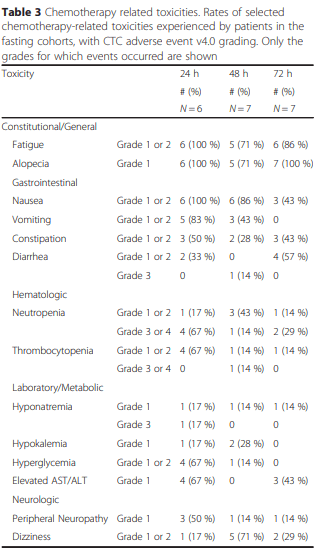
- Experienced less nausea the greater the fast and no vomiting
- DNA damage decreased for the 48h and 72 h cohorts but not for the 24h cohorts
- after fasting 48 or 72 h there was a decrease in Olive tail moment (a way to quantify DNA damage)
- Fasting may induce oxidative stress resistance
- 40% reduction in circulating insulin-like growth factor -1 IGF-1 as well as changes in IGF-1 binding protein
- IGF-1 has been shown to be one of the major growth factors that promote cell proliferation and growth.
- Inhibition of the IGF-1 signaling is associated with enhanced cellular protection against various stresses including toxins.
- IGF-1 is significantly reduced by fasting.
- IGF-1 has been shown to be one of the major growth factors that promote cell proliferation and growth.
- Inhibition of the IGF-1 signaling is associated with enhanced cellular protection against various stresses including toxins.
- May ID when a protective state may occur
- IGF-1 has been shown to be one of the major growth factors that promote cell proliferation and growth.
Other Findings:
- Chemotherapy toxicity to normal primary cells was reduced when cultured in conditions mimicking fasting
- Short term Starvation (STS) for 48 h prior to chemotherapy treatment significantly reduced side effects and death from high-dose chemotherapy when compared to mice fed with standard diets prior to recieiving chemotherapy.
- Short-term starvation prior chemotherapy administration protects mice against toxicity.
Study 5 [Resting energy expenditure in short-term starvation is increased as a result of an increase in serum norepinephrine]
Study Design
- 11 Healthy Lean subjects
- 7 women 4 men
- Studied from day 1 – 4 during an 84 hour fast
- Could only drink water or unsweetened mineral water
Findings
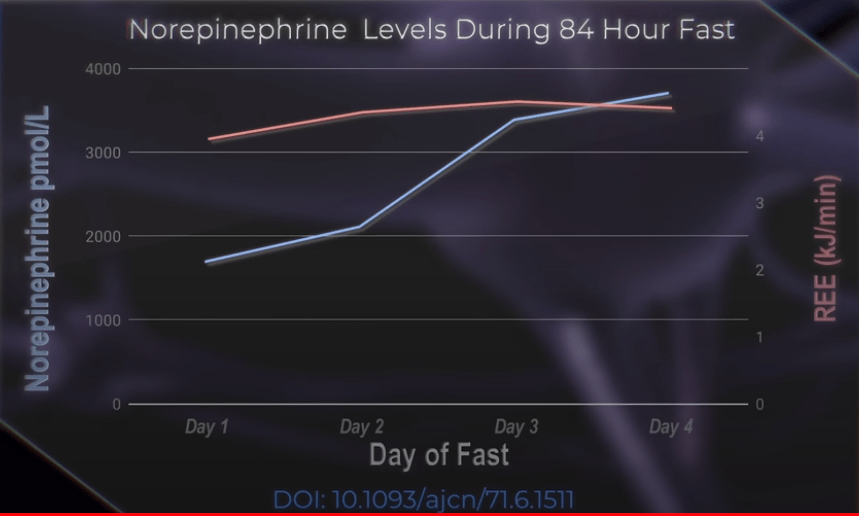
- Resting energy expenditure increases in early starvation
- increase in plasma norepinephrine.
- This increase in norepinephrine seems to be due to a decline in serum glucose and may be the initial signal for metabolic changes in early starvation.
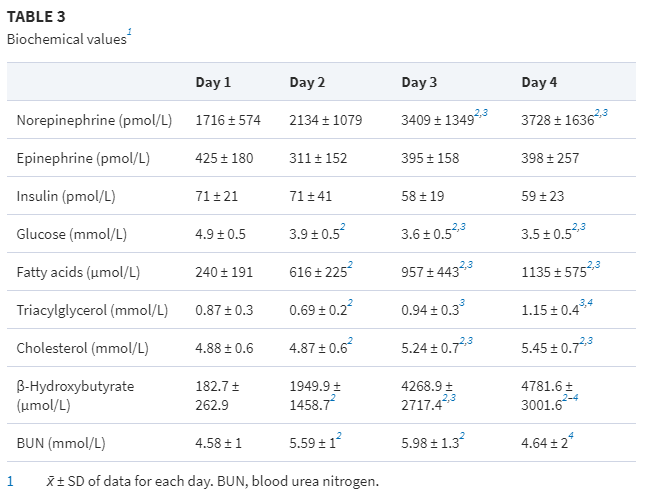
- Mean glucose concentrations decreased
- fatty acid concentrations increased significantly on days 2 and 3 and were not significantly different on day 4 (Table 3).
- Serum concentrations of b-hydroxybutyrate increased constantly during the study period.
- A decrease in triacylglycerol concentration on day 2 was
followed subsequently by an increase on days 3 and 4. - The concentration of cholesterol increased during starvation.
- An increase in the concentration of blood urea nitrogen on days 2 and 3 was followed by a decrease on day 4.
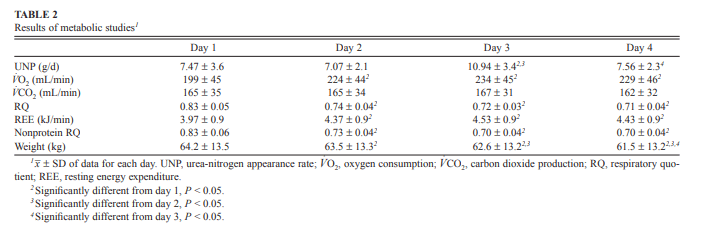
- Oxygen consumption and resting energy expenditure increased significantly between days 1 and 2 and remained high until the end of the study (Table 2).
- Carbon dioxide production rates remained unchanged,
- respiratory quotients and nonprotein respiratory quotients decreased significantly during the study period.
- The urea-nitrogen appearance rate was higher on day 3 than on day 2 and was lower on day 4 than on day 3.
- Norepinephrine concentrations increased during the study period.
- Serum insulin was lower on days 3 and 4 than on days 1
- and 2; however, this result was not significant (Table 3).
- Statistical analysis detected a significant correlation between the concentration of serum norepinephrine and resting energy expenditure, fatty acids, b-hydroxybutyrate, blood glucose, respiratory quotient, and body weight
This study showed that short-term starvation leads to a progressive increase in serum concentrations of norepinephrine, accompanied by an increase in resting energy expenditure, lipolysis, and ketogenesis in healthy, lean subjects. The concentration of insulin did not change significantly during the study period. Therefore, our results indicate that an increase in
serum norepinephrine concentration rather than a decrease in
serum insulin concentration initiated by the decline in blood
glucose concentration may be the primary initial signal of
metabolic changes during early starvation.
Norepinephrine – stimulatory hormone – promotes focus alterness and arousal
All subjects lost weight progressively during the study period
https://academic.oup.com/jcem/article/90/2/741/2836628
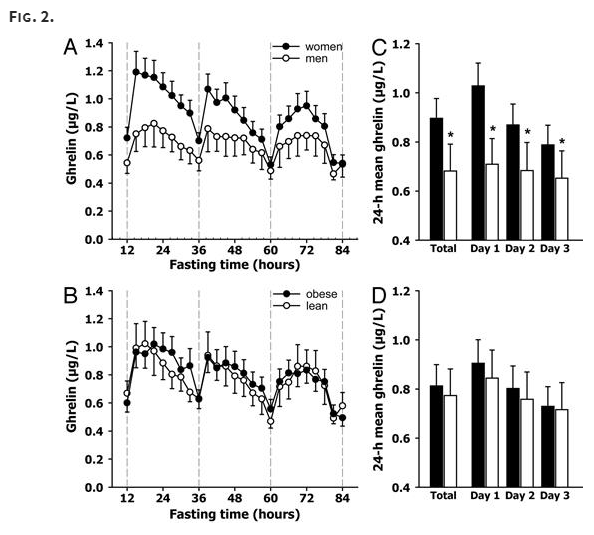
Lower ghrelin over time – less hunger as days go on
https://www.ncbi.nlm.nih.gov/pmc/articles/PMC4089087/
Fasting Induces IL-1 Resistance and Free-Fatty Acid-Mediated Up-Regulation of IL-1R2 and IL-1RA
 longevityvault.com